
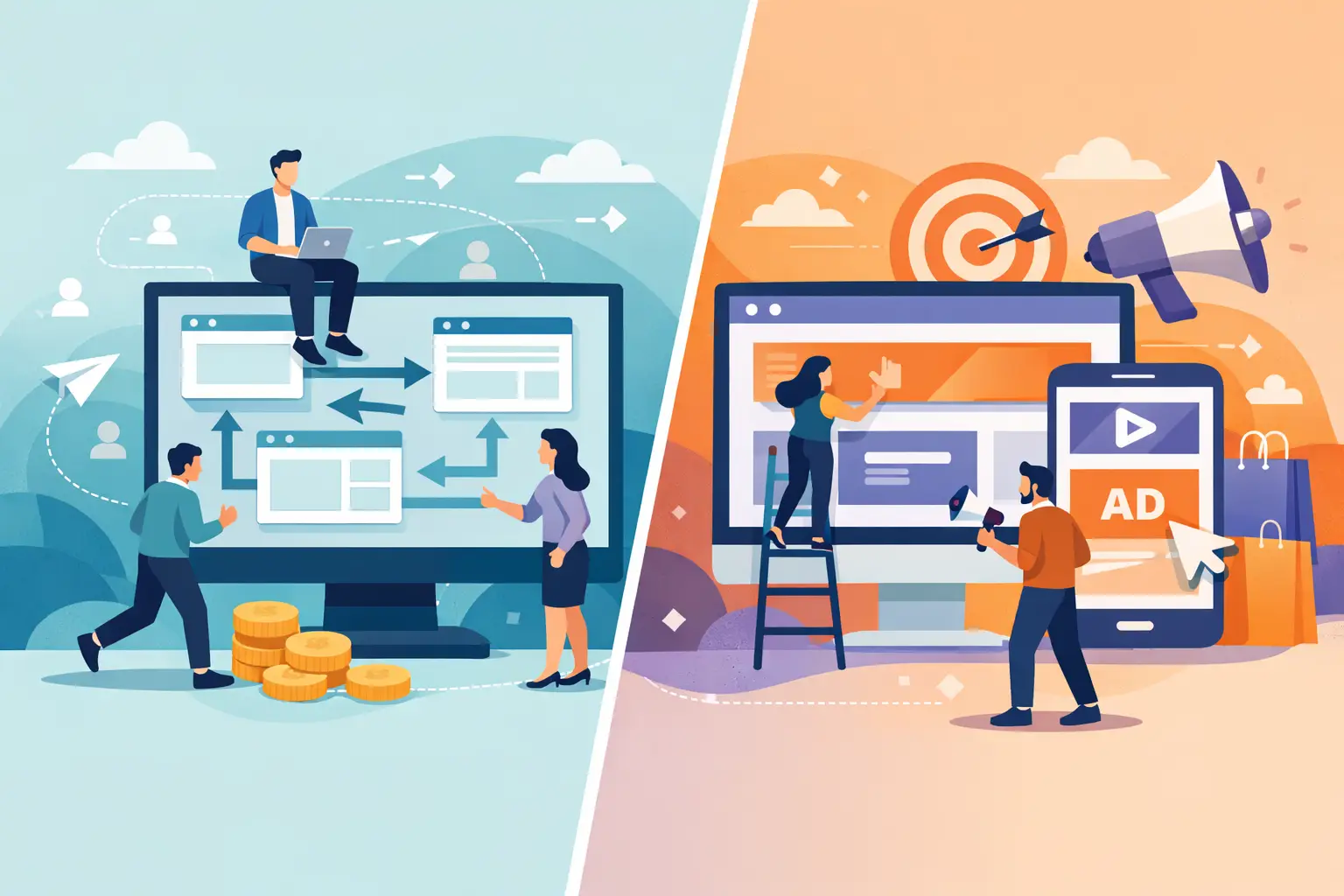
You can pay for clicks all day and still wonder why nothing moves. That is exactly why the traffic exchange vs banner advertising question matters – especially if you are building offers on a tight budget and need traffic you can actually test, measure, and improve.
For beginners, side hustlers, and small online promoters, these two traffic methods solve different problems. They may both put your offer in front of people, but they do not create the same kind of attention. One is usually about active exposure inside a participation-based system. The other is about visual placement and passive click attraction. If you treat them as interchangeable, you will waste time or money fast.
Traffic exchange vs banner advertising: the real difference
A traffic exchange is built around participation. Users view other users’ pages, often to earn credits, cash rewards, or platform benefits. In return, their own pages get shown to other members. The biggest advantage is simple: you can generate immediate visibility without the larger upfront costs that often come with traditional ad buying.
Banner advertising works differently. You place a visual ad in a banner slot and wait for the right person to notice it, click it, and visit your page. That can happen on websites, inside member areas, or across an ad network, depending on the platform. The key difference is intent. Banner viewers are usually doing something else when they see the ad. Traffic exchange users are actively cycling through pages as part of the system.
That changes everything – your click quality, your message, your expectations, and your conversion path.
When traffic exchange makes more sense
Traffic exchange is usually the stronger option when your goal is fast exposure, cheap testing, or early-stage promotion. If you just launched a landing page, affiliate offer, squeeze page, or simple product pitch, this model can help you get eyes on it quickly.
It is especially useful when you need data before you spend bigger. You can test headlines, page layout, calls to action, signup flow, and first impressions. If nobody stays on your page or takes action, you have learned something valuable before putting more money behind a campaign.
There is another reason this works for newer marketers: the barrier to entry is lower. You do not always need polished creative assets, advanced targeting skills, or a large testing budget. You can get moving with a basic page and a clear offer.
That said, traffic exchange traffic has limits. Many users are moving quickly. Some are there for rewards, not because they were already searching for what you sell. That means weak pages get exposed fast. You may see impressions without deep engagement unless your message is clear right away.
This is where the smart move is not just getting views, but matching the offer to the audience. Straightforward pages, simple promises, fast-loading designs, and obvious calls to action tend to perform better.
Best use cases for traffic exchange
Traffic exchange often works best for list building, homepage exposure, membership offers, earning platforms, low-ticket promos, and pages where the value is easy to understand in seconds. It is also useful when you want repeated visibility inside an active user base instead of waiting for algorithm-driven traffic.
For platforms that combine earning and promotion in one place, this model can be even more practical because the audience already understands action-based online offers.
When banner advertising is the better play
Banner advertising becomes more attractive when branding matters as much as the click. A banner can create repeat exposure even when users do not click the first time. That makes it useful for offer recall, product familiarity, and visual credibility.
If you have strong creative, a recognizable message, and a page that converts warm visitors, banners can work well. You are not relying on forced page rotation. You are trying to attract attention naturally with design, positioning, and relevance.
Banner ads also give you more control over how your offer is presented. You choose the image, the text, the style, and often the placement tier. That can help if your product needs visual appeal or if your message benefits from professional presentation.
Still, banner advertising has its own trade-offs. Banner blindness is real. People ignore ad spaces all the time. A weak banner gets skipped instantly, and even a good banner can underperform if it is placed in the wrong environment.
There is also a creative burden. If your design is poor, your click-through rate suffers. If your copy is vague, you pay for visibility that does not turn into traffic.
Best use cases for banner advertising
Banner advertising is often the stronger choice for product promotions, branding campaigns, retargeting-style exposure inside ad platforms, and offers that need visual storytelling. It can also work well when you want a more passive traffic source instead of actively participating in a traffic system.
Traffic quality: visibility is not the same as buyer intent
This is where many people make the wrong call in the traffic exchange vs banner advertising debate. They compare clicks without comparing attention.
Traffic exchange can generate faster volume, but the visitor may be in scanning mode. Banner ads may generate fewer clicks, but the click can be more intentional if the banner catches the right person at the right time.
Neither source is automatically better. It depends on what you need.
If your page is built to grab attention in three seconds and push a simple action, traffic exchange can do real work. If your offer needs a polished first impression and benefits from visual branding before the click, banners may convert more efficiently.
The best question is not which one gets more traffic. The better question is which one matches your conversion path.
Cost, speed, and testing flexibility
For users with limited budgets, traffic exchange usually wins on speed and testing flexibility. You can start small, rotate pages, swap copy, and collect fast feedback. That makes it attractive for side hustlers and beginner promoters who need momentum without a major ad spend.
Banner advertising can cost more depending on placement quality, duration, and competition. But if the placement is strong and the audience is relevant, that higher cost can make sense. Better traffic does not always look cheaper upfront.
A practical rule is this: if you are still figuring out your offer, start where testing is cheaper. If you already know your funnel works and you want more branded exposure, banners become more appealing.
Should you choose one or use both?
In many cases, the smartest move is not choosing one forever. It is using both in the right order.
Start with traffic exchange when you need proof. Test your hook, page, and CTA. Watch what gets signups, clicks, or sales. Once you know what message gets attention, banner advertising can amplify it with better creative and stronger placement.
That progression makes sense because it reduces guesswork. Instead of designing banners around assumptions, you build them around what already got results.
For example, if one headline consistently pulls action in a traffic rotation, that line may belong on your banner. If one landing page gets longer visit time, that page may deserve your paid placements.
This is where all-in-one platforms can create an advantage. If you can earn, promote, test offers, and scale visibility inside one system, the learning curve gets shorter. Sumrria fits that model well because users are not forced to split their workflow across multiple disconnected tools just to start getting eyes on an offer.
How to decide faster
If your main goal is immediate exposure, low-cost testing, and simple promotion, traffic exchange is often the better fit. If your main goal is visual branding, passive click capture, and stronger creative control, banner advertising usually makes more sense.
If your budget is small, your page is new, or your funnel is unproven, traffic exchange gives you room to experiment. If your offer is already converting and you want better presentation with repeated visual exposure, banners deserve a closer look.
The worst move is expecting either method to fix a weak offer. Traffic does not rescue confusion. It magnifies it. A clear promise, a relevant audience, and an easy next step matter more than the traffic source itself.
So if you are deciding between the two, do not ask which one sounds more professional. Ask which one gives your current offer the best chance to get seen, understood, and acted on. Start there, improve what the market tells you, and keep building from real response instead of guesswork. That is where growth starts to feel less random and a lot more profitable.