
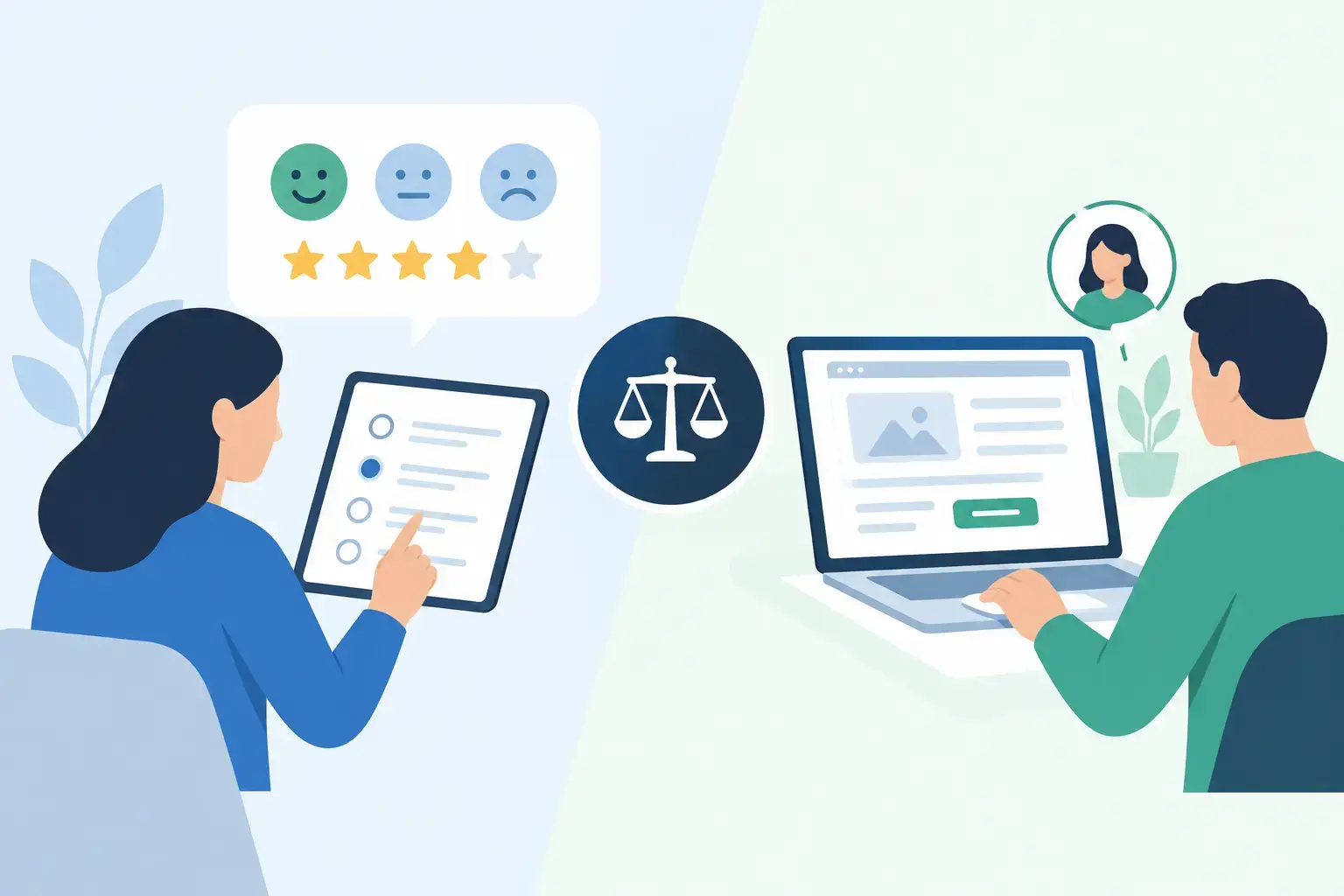
A visitor sees your promotion, clicks through, and leaves without signing up. Was the offer weak? Did the page load slowly? Was the headline confusing? Or did they simply want something different? The answer changes what you should fix next. That is where surveys versus usability testing becomes a practical business decision, not just a marketing term.
For online earners, promoters, and small business owners, feedback can protect your time and ad budget. Surveys help you hear what people say they want. Usability testing helps you watch where people get stuck. Both can improve an offer, landing page, app, or membership flow, but they solve different problems.
Surveys Versus Usability Testing: The Core Difference
A survey asks people questions. It collects opinions, preferences, experiences, and self-reported behavior at scale. You might ask which type of offer a member wants to promote, how satisfied they are with a signup process, or what would make an upgrade feel worthwhile.
Usability testing asks someone to complete a task while you observe their experience. For example, you may ask a participant to create an account, find a traffic promotion option, submit a website, or locate their earnings balance. The goal is not to hear a general opinion. It is to see whether the experience works in the moment.
Think of it this way: a survey can tell you that 68% of users say your dashboard is easy to use. Usability testing may show that several of those same users hesitate for 20 seconds before finding the feature they need. People often report what they believe they did, what they intended to do, or what sounds reasonable. Their real behavior can reveal a different story.
Neither method is automatically better. The right choice depends on the decision in front of you.
What Surveys Do Best
Surveys are built for reach. If you need feedback from a broad group of members, customers, leads, or task participants, a short survey can quickly identify patterns worth investigating.
They work especially well when you need to measure sentiment. You can learn whether people feel the rewards are valuable, which earning activities interest them most, how they discovered your offer, or what barriers keep them from upgrading. This kind of feedback helps you prioritize messaging, benefits, and promotional angles.
For example, an online promoter could survey their audience after sharing a new offer. Ask what caught their attention, what made them hesitate, and what information was missing. If a large share says they were unsure about the cost, eligibility, or time commitment, your next version of the promotion should answer that question earlier.
Surveys are also useful for comparison. You can test reactions to two headlines, several payout options, or different categories of products people want to see. The strength is volume: even simple questions can provide directional evidence when enough relevant people respond.
But surveys have limits. A respondent may say they would use a feature without ever using it. They may forget where they struggled. They may rush through questions for an incentive. Poorly written questions can also lead people toward an answer and make the results look more certain than they are.
Use surveys when you need to understand what people think, prefer, value, or claim they need. Keep questions focused, neutral, and short enough that people will finish them carefully.
Better Survey Questions Get Better Decisions
Avoid vague questions such as, “Do you like our platform?” A yes or no answer gives you very little to act on. Ask about a specific moment instead: “What stopped you from completing your promotion setup?” or “Which earning option would you like to use more often?”
Open-ended questions can uncover language your audience actually uses. That language can strengthen your ad copy and landing pages. Rating questions make it easier to spot larger trends. Combining both is often more useful than relying on one format alone.
What Usability Testing Does Best
Usability testing is for finding friction. It shows where a real person loses confidence, misunderstands a label, misses an important button, or gives up before completing a valuable action.
This matters whenever an action affects conversions. If people struggle to register, submit an offer, start a task, choose an upgrade, or find referral details, more traffic will not solve the problem. You could pay for clicks that never become results.
A usability test does not need to be expensive or complicated. Give someone a realistic goal, then stay quiet long enough to see what happens. Say, “You want to promote your website to active members. Show me what you would do first.” Watch their screen or ask them to describe what they are looking for as they move through the process.
The most valuable moments are often small. A participant may skip a button because the label sounds technical. They may expect pricing before they create an account. They may not understand the difference between a free feature and an upgrade benefit. These are clear opportunities to improve the experience and reduce drop-offs.
Usability testing is not designed to tell you what thousands of people believe. A small group can expose obvious problems, but it cannot reliably measure market-wide demand. It is qualitative evidence, which means its power comes from the detail behind each struggle.
Use usability testing when you need to know whether people can successfully complete a task and why they fail when they cannot.
What to Watch During a Test
Pay attention to more than whether the participant finishes. Notice where they pause, backtrack, reread instructions, click the wrong item, or ask a question. If multiple people hit the same obstacle, it is probably not a user problem. It is a design, copy, or flow problem.
Ask follow-up questions after the task, not during it. Interrupting too soon can accidentally coach the person through a confusing experience. Once they finish, ask what they expected to happen and what felt unclear.
When to Use Surveys, Usability Testing, or Both
If you are deciding which benefit to promote in your next campaign, start with a survey. You need a wider view of what your audience values. If you already know the benefit people want but your conversion page is underperforming, run usability tests. You need to see where the path breaks.
The strongest approach often combines both methods in sequence. A survey identifies the biggest opportunity. Usability testing helps you build or improve the experience around that opportunity. Then another survey can measure whether satisfaction or clarity improved after the changes.
Imagine members say they want more ways to earn from promoting offers. That survey result points to demand. Next, test whether they can easily find the promotion tools, understand how traffic rotation works, and choose the right option for their budget. If they cannot, the demand is real but the path to action is weak.
This is especially relevant in membership-based platforms. A feature can sound valuable in an email or banner ad, yet still fail to convert if members cannot quickly understand how to activate it, what they receive, and why it matters. Clear feedback closes that gap.
A Simple Feedback Plan for Growth
Start with one business goal. Do not ask for feedback just because feedback sounds useful. Pick a result you want to improve, such as more completed signups, more offer submissions, stronger upgrade conversion, or better repeat engagement.
Next, choose the method that matches the uncertainty. If you do not know what your audience wants, survey them. If you do not know why they abandon a process, observe them using it. If both questions matter, use both methods without treating either result as the full answer.
Keep the sample relevant. Feedback from people who never use online earning platforms may not help you improve an experience built for active promoters. For a platform like Sumrria, input from people interested in earning, advertising, and recurring commissions will be far more actionable than random opinions.
Finally, make one improvement at a time when possible. Change the headline, simplify the first step, clarify a benefit, or move a key detail higher on the page. Then measure what happens. Big redesigns can hide which change actually improved results.
The Best Choice Is the One That Removes Guesswork
Surveys give your audience a voice. Usability testing gives you a window into their actions. One helps you understand demand; the other helps you remove friction between interest and results.
Before spending more effort driving traffic or launching another promotion, ask a sharper question: do you need to know what people want, or do you need to see what prevents them from getting it? The answer can turn feedback into clearer offers, smoother experiences, and more opportunities to earn and grow.